Friday, 31 May 2013

Gilles de Rais = Bluebeard?

Going back over one of the pieces of research that Gini handed Casey and I about Sally Clark from the Canadian Enycyclopedia, I noticed something very interesting. There is only one line on that page that even references her writing of Jehanne of the Witches, and in that line the encyclopedia refers to Gilles as "mass murderer, otherwise known as Bluebeard". Surprised at not having noticed this before, I quickly googled "Joan of Arc and Bluebeard" and several interesting things popped up. The one I found most interesting is this website  Sur La Lune Fairytales which documents the history of the legend of Bluebeard, as well as various similar stories and modern translations. I was astounded at how many titles I recognized, with characters that are allegedly inspired by Gilles de Rais' deeds! You can find the list on the website; I reccommend checking out the list of modern interpretations - Bronte's Jane Eyre and Atwood's The Robber Bride are both on the list!

Illustration for Mr. Fox by John Batten (a tale similar to Bluebeard)
Found under "Illustrations" on the site

 Although, I find it quite fascinating that the story itself has translated from Gilles mass killing of young sodomized boys to the killing of "badly-behaved" wives. The gender politics at play are astounding. I have always recognized the legend of Bluebeard as coming from a long history of "Bad Wives Tales" meant to keep the medieval wife in line, depicting Bluebeard as less monsterous for his actions (barf). Yet, the argued origin of the story as coming from the accounts of Gilles de Rais' actions does portray a horrible, mass murdering human being. YET, Sally Clark seemingly sympathizes with his character, especially since she places the whole play from his point of view. I don't even know what to make of all of this!

WAIT: I just checked back and realized the website actually attributes both the Gilles de Rais origin and the "bad wives tale" motive as possibilities for the legend:

"Bluebeard was already a folk tale by the time Charles Perrault wrote it down and published it in 1697. The history of the tale is debated, but the popular opinion is that the tale developed from the legend of Gilles de Rais (aka de Retz) (Murphy 1996).
Gilles de Rais (1401?-1440) was a Marshal of France and served under Joan of Arc before her execution. He was a French national hero for helping drive the English out of France. After the crowning of the Dauphin and the death of Joan of Arc, de Rais settled into his estates in Brittany and turned deviant. He practiced alchemy and black magic while he was a great patron of the arts. He enjoyed killing, usually by decapitation, young boys after he he had sodomized them. His fame and influence kept people from noticing that children were disappearing from his lands. Some speculators think the story of Bluebeard arose among the peasantry to warn their children to stay away from the dangerous baron whom they had no other protection against due to his political and financial stature. Finally, the Duke of Brittany investigated the murders and dug up the remains of 50 boys in de Rais' castle. He confessed to 140 killings at his trial, but he might have killed up to 300 people. He was burned alive and hanged simultaneously for his crimes on October 26, 1440 (Mendoza 1998). You can read more about Gilles de Rais at Antonio Mendoza's The Serial Killer Hit List--Part 1 site.
Other critics do not think the story is based upon the story of Gilles de Rais, but is actually based on older stories such as "Conomor and Triphine" and "Cupid and Psyche." These stories are addressed more on the Tales Similar to Bluebeard page. This theory centers on Bluebeard's interpretation as a cautionary tale against curiosity and temptation (Warner 1994).

Yet another theory of Blue Beard's origins is centered upon the fairy tales being seen as women's stories, passed down through generations from mother to daughter. Bluebeard can also be interpreted as a cautionary tale about real life. The story isn't warning against temptation and curiosity in marriage, but the practical consequences of marriage. In the time when childbirth was a main cause of death for women, mothers warned their daughters that marriage could be deadly since you could be killed by your husband with the simple act of becoming pregnant by him. In this way, the tale loses its sadistic killer and becomes a tale of normal life (Warner 1994)."

Anyway, just felt like I should finally post and although this might not be relevant, it's just one thing I have noticed that I think is pretty intriguing. Check out the site and let me know what you think!

Brittany

Thursday, 23 May 2013

The Messenger (1999)

Two days ago I watched The Messenger: The Story of Joan of Arc (1999) directed by Luc Besson. If you want to watch it, I watched it here

Here are some of my preliminary notes regarding the movie:

The voices are not featured in the movie at all. Whenever Joan talks about the experience she refers to an image of a boy who grows onto a man as the movie progresses. Once he is a man his face keeps bleeding in her visions. Then he grows into Dustin Hoffman who tries to convince Joan that she was not sent by God to carry out her mission, it was her own idea. The movie had a very different perspective than our show, as by the end it is made for the audience to believe that Joan made it up.

Also, the movie is completely focused on her battles. She is in battle 3/4 of the movie, and when she is not in battle, she is being tried for killing people in battle and wearing mens clothes. Thought it was interesting to see the opposite of our show, which is not focused on battle at all.

As mentioned before, the voices are in the form of a man, makes me think more and more that Sally made the voices women to connect them to the Old Religion

Jehanne portrayed as an odd ball since she was a child. Even the priest was sick of her being in church all the time.

Completely different version of finding the sword:

Isabelle stabbed and raped at the beginning of the movie?? Also as she is dying, she is asking  for God's forgiveness, which would not support Isabelle being of the Old Religion.

Made up a gimmick to see if Jehanne could find the try king, gets a messenger boy to play Charles. Gilles volunteers to be Charles, Charles says, "You would like that wouldn't you Gilles"

Gilles and Jehanne have PRETTY MUCH NO RELATIONSHIP. He makes fun of her, they battle together, he carries her inside when she gets shot by an arrow, that's it.

Important characters to the movie that are not in our show: Yolande of Aragon, Tremoy?, Jean de ma? (messenger boy)

George is not in the movie, Cauchon is always in the court

Huge emphasis on Jehanne writing to the King of England to ask them to surrender, multiple times.

Included the examination at Poitiers as a scene for some reason

Jehanne goes psycho by the end of the movie, progressively getting crazier and crazier. She has no self- confidence, just screams at everyone and waves her sword around, repeats the line, "I'm just the Messenger" over and over

Thought it was interesting when she gets shot with an arrow, one of the men say "If God sent her then why would he let her be wounded so bad." SACRIFICE

The only time Jehanne and Gilles kind of even have a little bit of a relationship is when he is concerned that she got hit with the arrow

Charles' mother in law (Yolande of Aragon) tainted the holy oil that crowned Charles King of France???? (Inciting incident that starts the falling action [everything going awry for Jehanne, burning])

The movie makes it for us to believe that Charles designs the opportunity to give Jehanne to Burgandy, the captains that she fought with in the battles give up all their money to save her, Charles gives it to Cauchon. Cauchon may be working in tandem with Burgandy and Charles to make sure she dies??

Then he gets scared that she could actually be sent by God and burning her would then be a bad choice so he tries to save her but it doesn't work because Dustin Hoffman convinces her to burn.

Dustin Hoffman credited as "The Conscience" ..

All in all, very different takes on the story then Sally Clarke's but definitely worth the watch to see the different choices. I want to do more digging to see how much they say the movie was based on research and how much was fiction. Still trying to find a good link to the Bergman movie


Friday, 17 May 2013

Salome


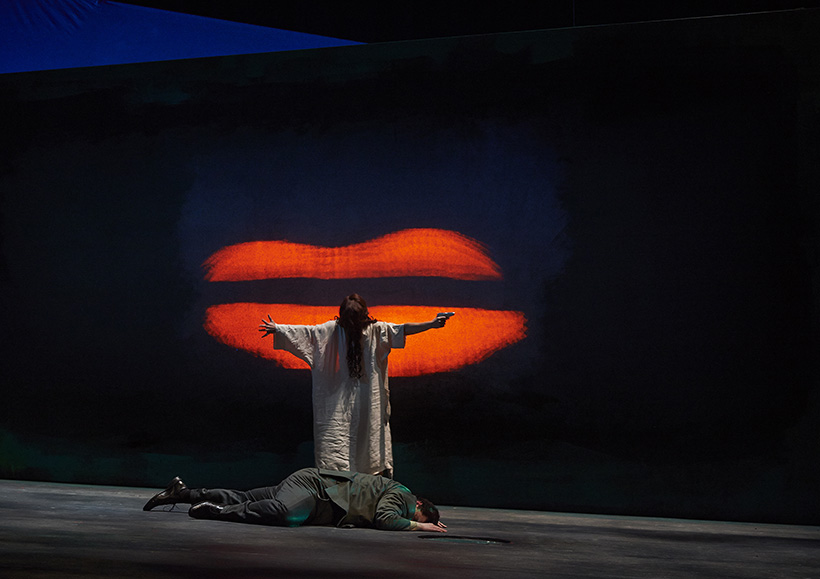
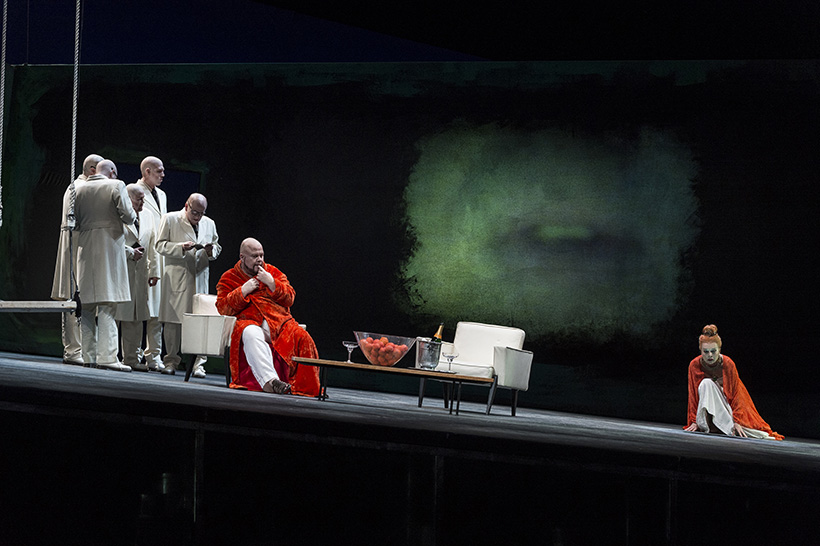
COC's production of Salome features extensive projection work, including that of the disembodied mouth of Jochannan, real-time and rear projected on the back wall of the set./


Kay Armatage writes in the essay Seeing an Hearing Atom Egoyan's Salome, "the video camera, held in such close proximity to the mouth, replaces the microphone, amplifying the visual rather than the aural - indeed, dissolving the aural into the visual." "The enormity of the image...is a visual reminder of our presence as an audience, for whose pleasure (and horror?) these crimes are committed." "this visual image is privileged for the audience alone." (Kay 315).

This production also used a giant cotton screen raised up with an actress as another screen, projected onto from the front (for larger images) and back (for smaller projections).


Selected scenes from Salome:


From the COC Youtube Channel

Link to Inside Opera: Salome, Playing with Shadows. This video shows shadow designer and artist Clea Minaker as she talks of her challenges in designing the shadow art for the show.


Citation: Burwell, Jennifer Lise, and Monique Tschofen. Image and Territory., 2007. Print.


Thursday, 16 May 2013

Beckett's "Not I" - Disembodied Voice

Samuel Beckett's "Not I" staring Billie Whitewall. Script and notes about production here.


REFWORKS bibliography

I have made a REFWORKS bibliography folder for us all to share our research in - the folder name is called Jehane" and the password is "Jehane!" [so complicated!]

please use this so we can share any library database and other web archived info - if you haven't used REFWORKS before I highly recommend you watch some of the tutorials: http://www.youtube.com/proquestrefworks

login here: http://refworks.scholarsportal.info/refworks2/?groupcode=RWBrockU

you may need to make an initial account - everybody with a brock email address may subscribe, in most cases all you have to do is enter the information above and you are ready to research!

/d

Tuesday, 7 May 2013

early musings

Darkness victim blood barbaric...we can't know its a play...use of medieval format as meta play structure....we see presence of the divinity in the theatre...ref. oracle of Salome....prehistoric?...savage... wild.....ref. hundred years world....dark ages....female religion destroyed by the male religion.....Gilles is educated man and an animal...rem didn't start killing the boys until after Jehannes death...