Friday, 28 June 2013

Savages rock-on


The interview with this band The Savages was rebroadcast this morning on Q:
http://www.cbc.ca/q/blog/2013/06/28/savages-stun-with-silence-yourself/


Of note, they screened the first Joan of Arc film in the studio while recording their album :-P

you can here the interviews and studio-performed tunes here:
http://www.cbc.ca/q/popupaudio.html?clipIds=2354574631,%202354574970,%202354572116


. . I thought I was hearing my fave band, Siouxie and the Banshees . .


***NOTE THE OPENING SEQUENCE of Cities in Dust!


Thursday, 27 June 2013

Cool Website of Joan of Arc Literature and Media

Hey guys,

Check out this site. Trying to work through as much Joan of Arc lit and media as I can has been quite the process but this site is pretty helpful! It has full version texts, various images, and even video games! It also has history; overviews, biographies, chronologies and timelines!

http://www.jeanne-darc.info/p_multimedia/0_literature.html


Not sure if this will interest anyone else but as I said, its been useful for me.

Talk soon,

Brittany

Wednesday, 26 June 2013

Lorde - Tennis Court


thinking costumes . . .


Reading the play: notes from Gini in June 25

Hi, all,

I have finished typing Act One of the script. I haven't started the 
suggested cuts; I am waiting until I have the whole thing in computer.

In the process was I very struck with how important POWER and CONTROL 
are in the play. Who holds the power and how they wield it, how they 
get it. This really gelled for me in scenes 10 and 11. In scene 10 
Michael gives Jehanne the advice that she should be rude to be taken 
seriously and we can clearly see her applying that in the second half 
of the scene (with Gilles) and then in scene 11. What was really 
striking is that SHE says she wants more power and THEN Catherine and 
Margaret make it happen (with Michael sort of tagging along). That is 
when they "enter" her and say they will live through her. There is a 
marked change in her after this. She "uses" Gilles in scene 10 and 
then George is outraged by it in scene 11.

It also made me think of the power of others to shape the story after 
the fact (both fictionally and in real life - all the stuff we "know" 
about Jehanne).

Also bearing in mind one of the writers about her trial (modern) 
commenting on how savvy and carefully worded her replies were in the 
trial and after her recanting her confession. She seemed to have 
linguistic skill above her background.

More to follow.

Thursday, 20 June 2013

4D Art: Projection Magic

Michel Lemieux and Victor Pilon are the Artistic Directors of the highly acclaimed company 4d art. This company creates magical theatrical pieces with highly advanced ,and closely guarded, projection technology.

Above is the sneak peak into their newest production La Belle et la Bete, a relook at the classic tale of Beauty and the Beast.

Another critically acclaimed show, Norman.


And their version of Shakespeare's Tempest.

4d art takes projections and makes them part of the story. Entire characters are only holograms. They use them to show a change in space or time. It adds a supernatural element, as projections and holograms can do and show things not normally possible (like the couple aflame in the first video, and giants in the third)

An idea for the voices perhaps?

Tuesday, 18 June 2013

Anorexia Mirabilous: Pious Woman's Practice (as it relates to Jehanne)

In a paper in first semester, I discussed food and consumption as a means of control for the medieval woman.
  • One one hand it provided the lower class female control over her husband - she could poison her husband's food if she wanted to since she had a direct relationship to his food through preparation.
  • The restriction of food was also a popular means of control for the medieval woman. The practice of restricting one's own food intake for spiritual purposes was known as anorexia mirabilous, and it was practiced by pious women.

Pious women would starve themselves in the name of God, which was an assertion of power in itself over their bodies and their religion. These women would accept only the Eucharist (in Catholic churches) and therefore be cleansed of everything but the Body of Christ. These women believed that doing this would elevate their position, placing them on almost the same level as the priest as they would be empty of all else but Christ. Their body became a cavity for Christ rather than an item to be subjugated, used and taken by men and patriarchy (although the image of a woman’s body as a cavity for Christ still suggests female passivity…).  This practice was carried out by “miraculous maids” – it was a practice that went along with the ideology of ascetics. These women would wear hair shirts, sleep on beds of thorns and partake in  life-long virginity. It was a self-mutilating and self-deprecating practice.

 
One of the most famous women to practice this behaviour was Catherine of Siena. She would consume only one spoonful of herbs per day aside from the Eucharist, and if she consumed anything else she would force herself to throw it up by shoving a tree branch down her throat. Many of the women practicing this anorexia mirabilism died by starvation (but that was alright because she was sacrificed in the name of her faith).  This practice was deemed heretic during the renaissance and began to phase out, but the practice itself did not go away, merely the reason for practicing. No longer spiritual, the practice translated itself into "disorders" such as we know them in twentieth century -  anorexia and bulimia nervosa. HOWEVER, while these medieval practices of starvation and deprecation are only arguably the precedent for current day eating disorders such as anorexia nervosa and bulimia, there is something to be said for the parallels between the practices.

So Jehanne might have been aware of this practice and partaken in it? Interesting. Would account for her boyish body and lack of menstruation.  

The Slow and Precious Gaze


The Life and Death of Marina Abramovic

Robert Wilson, Marina Abramovic, Antony, Willem Dafoe

Marina Abramovic has earned international renown and acclaim for the boldness and startling originality of her work. But when Abramovic decided to put her life story onstage, she opted to hand the reins to another avant-garde genius, internationally acclaimed director and visual artist Robert Wilson. The remarkable result, The Life and Death of Marina Abramovic, features Abramovic in dual roles-as herself and her mother-and Willem Dafoe as the narrator and her male counterpart, with music written and performed by Antony of Antony and the Johnsons, and costumes by Jacques Reynaud.

Following its premiere at Manchester International Festival and a sold-out European tour, this groundbreaking achievement, tracing Abramovic's journey from her troubled Serbian childhood to her ascension to the world's artistic elite, makes its North American debut at the Luminato Festival.

text and photos from: http://luminatofestival.com/events/2013/life-and-death-marina-abramovic


stylistically related to . . "SHAKESPEAR`S SONETTES"


Edouard de Reszke as Mephistopheles in Gounod's Faust 1983 (MET)


Monday, 17 June 2013

Reading the Play: More Notes from Gini to DV et al


Notes about Jehanne, 17 June 2013

Gini is looking further at Gilles, as he has created Jehanne as both monster and saint
Is he sinking deeper into madness?
Is he not sane? insane? Note his behaviour after her death . . . 

Can we structure this as a spiral? Does he only imagine things? Some things?  Does he misinterpret?
Is the play about his spiral into madness? And he drags everybody into his sphere of madness . . or it infects them as it secretes out from his sphere . . .

The contents of his play are controlled by him, these facts are revealed in the presentation of Clark’s play.
This is the DARK side. . . . 

Now from the directorial side:
The DART and the LIGHT.

There are spiritual things in the world that we are not capable of explaining.  When she does appear to him, when he succeeds in conjuring her [or does she just appear? And by what agency?], and they get into an argument, it’s apparent that there are things that are not easily explained, scientifically or logically.  It needs to remain “supernatural,” to remain in a space of wonderment, we may recognize it but we may not be able to explain it.

What is it about their relationship that makes him go crazy after her death?

The play should end with a great conflagration, his death by fire.
 -----
The problem with Marie at the end of the play: not played by Jehanne. (as cast: Nikki)

Costumes notes: Marie should be in period mourning costume of the era that Gilles dies (1440)
-----
The play: it’s apparent that Clark may not have known how to finish the play.

. . . a play where the characters dress in costume in order to confuse the protagonist who has taken a fall (and is and disoriented) in order to maintain an elaborate ruse . .

----------

Gini's corresponding remarks in an email to the team:

Casey and Brittany,

I had a meeting with David today to share some thoughts.

We are all agreed that we are focusing on Gilles' "production", which 
he is performing to lure Jehanne to appear. I am thinking about 
approaching the play as his decent into madness. So things become 
increasing warped and dark as it goes along. And it culminates in his 
cutting Francois' throat.

But, at the same time, I want to preserve a bit of the mystical or 
supernatural, in the sense that there are things in life which are 
either beyond our comprehension or our desire to pursue. I think that 
when Jehanne does appear, this is such a moment. The fact that 
Francois is channeling Jehanne is possibly another such point - and it 
becomes stronger and stronger (the more scared he gets about the end).

The question is what is so important about Jehanne to Gilles that her 
death first drove him to the put on the great pageant, but more 
importantly, in our play, to play the rest of her life out.

I also see Marie as perhaps the only one in full period costume and in 
mourning version of that.

I have also suggested a great conflagration (Gilles' death) made of 
lights and effects (no live flame allowed - and artifical can be much 
more impressive).

I would like us all to think of images that we think of when madness - 
for example, going down a dark vortex or being surrounded by dark 
images and strange noises. Please - post what you see/hear.

Gini
 

Reading the Play: Notes from Brittany

Considering Religion:
 - the voices, as they begin to fade, representative of the old religion fading as well?
 - questioning the influence of the old and new religions on Jehanne (who, how)
    - ie: mother's resistance to allowing Jehanne to speak the "Our Father"
- a question of sex? patriarchy vs. matriarchy...

*could be 3 or more religions at play here... why significant to consider more than old vs. new?

*Jehanne's sin has always been pride


*Power Relations:... the church deciding whats holy and what is not (the conversation Jehanne has with the Priest during confession regarding how you know whether you're a saint...)

Jehanne's Agency:
 - Very obedient girl at first... always answering "yes" even when it seems inappropriate to do so
 - eventually she is no longer so "obedient", beginning to say no, becoming more powerful and even rude

*HOWEVER, is this agency? Or mere obedience to the voices, esp. Catherine as she takes over her body?

*She is constructed as a puppet - her agency is not really hers at all (according to Gilles)
 - And is Catherine REALLY inside Jehanne? Very difficult question since this all comes from Gilles.

**this leads to questions surrounding consumption - Jehanne CONSUMING these saints.... question of what she ACTUALLY eats - refers back to a popular practice by Catherine of Sienna who fasted to be closer to God, eating only a spoonful of herbs a day and if she ate anything she'd purge, sticking twigs down her throat. Many pios women died from this but very popular, emptying yourself up to be a cavity for the holy spirit to enter you (sexual connotation in my opinion... interesting stuff)

Gender Relations:
 - relating back to religion as well.. much less from Michael in Act II, more about what the female saints can deal with than the male saint.... but then at the end of the play Jehanne reveals that all of the voices were women so this is also complicated

*Francois - can really channel Jehanne - a method actor
 - is he the angel spoken of by Gilles and the first priest in the text?
 - how does Gilles feel about him? Is he the best Jehanne?


The first full cast scene is 1.8, the last is 2.8 (interesting to me)

Reading the Play: Notes from Casey

The most prominent idea coming from the read through was exploring the relationship of Gilles to his play,  seeing where his influence may have changed some scenes, and finding the true moments that he couldn't change. The preface by Clarke Rogers that you gave us was incredible, I love when he said, "it becomes clear throughout the play that Clarks intention is to reveal that the saint and the monster are two parts of a larger, more primal whole, and that neither is what they appear to be." I think this needs to be a big part of how we move forward, and the key to showing the audience 
what is the play and what isn't the play.

My notes from the read through are as follows:

Act 1 Scene 1:
- mishchievous feel. where and why?
-mentioned mission accidentally

Scene 2:

Isabelle: not saying our father prayer specifically, because of religion centred around mother, problem with Christianity. (many references throughout the play negative toward men and christianity: 
christian men beat their wives etc.)

Scene 3:
state of grace connects to real trial to presume you are in a state of grace: sin of pride

pg. 33 1/2 way scene switches to present very suddenly

Read Not wanted on the Voyage (pay attention to the carriage, Lucy/Lucifer)

Scene 4:
Michael strting to get pushy
power time and blood connection

Isabel keeping Jehanne at home, little girl, youngest child

Scene 8: full cast scene
Gilles wrote himself the part in court, very well may not be the part he actually had Jehanne as puppet

pg. 70 tarot reference: Catherine Queen of Swords

Scene 11 Priest as Pierre (from 1st scene of Act 1)
end of scene 11, goes back into play transition from staging the play to real life

Act 2 Scene 1:
Catherine taking over body, responsible for new meanness and strength

Jehanne as a shell, Catherine taking up all of her energy, strength and will to fight

Scene 2: war cry - Saint Joan also mentions odd war cry

Scene 5: Charles knows she is the saint, could potentially have to do with history as Charles was the one who gave her to the english, could potentially be a metatheatric moment where the actor is warning Francois crying, Catherine [in hindsight not sure what that was]

Monday, 10 June 2013


Arya Stark from Episode 9 Season 3 of Game of Thrones


Arya is a spirited girl interested in fighting and exploration. Arya wants to learn how to fight with a sword and ride in tourneys. Arya is particularly close to her half brother who encourages her martial pursuits. He gives Arya her first sword, Needle, as a gift. Throughout her travels, Arya displays great resourcefulness, cunning, and an 
unflinching ability to accept hard necessity.

Arya appearance is a long face, grey eyes, and brown hair. She is skinny and athletic. At the start of the story, she is generally regarded as plain, as exemplified by her nickname "Arya Horseface", and often mistaken for a boy. 
She is left-handed, quick, and dexterous. She learned basic swordplay in the Braavosi Water Dancer tradition and later learned how to handle knives. She received a noble's education at Winterfell and is said to be good with mathematics and an excellent horse rider. She has a quick and curious mind and a pragmatic outlook.
In her nine years, she has quickly shown herself to be an independent and wild-spirited girl. Unlike her sister, she rejects the notion that she must become a lady and marry for influence and power, showing no interest in the womanly arts of dancing, singing, and sewing; instead she revels in fighting and exploring.

Thursday, 6 June 2013

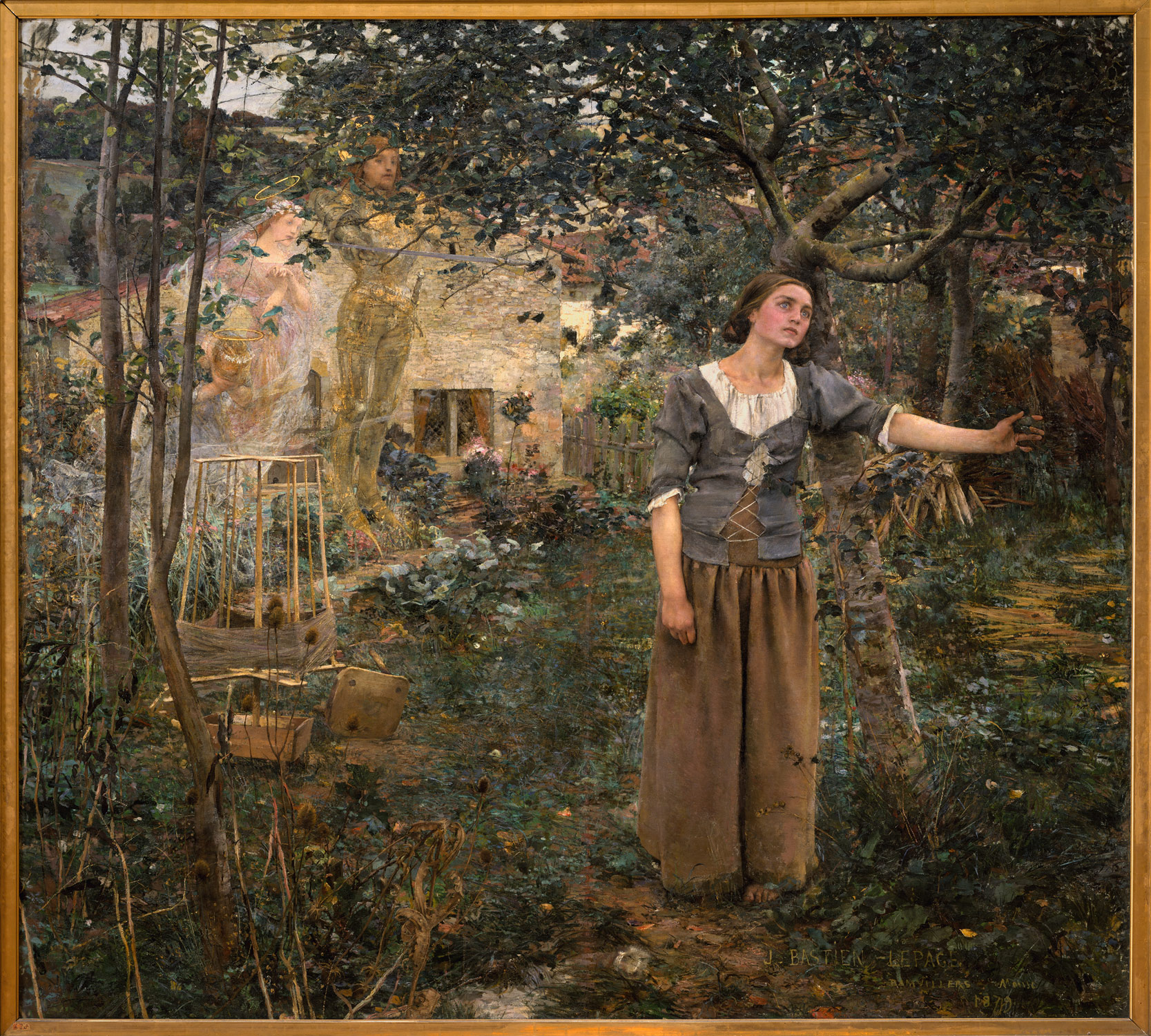
Joan of Arc, 1879
Jules Bastien-Lepage (French, 1848–1884)
Oil on canvas
100 x 110 in. (254 x 279.4 cm)


#9 – The Passion of Joan of Arc (1928), dir. Carl Theodor Dreyer


Shackled round the ankles and dressed simply in boy’s clothing, Joan of Arc is escorted into a austere white room to be jeered and ogled by hostile soldiers and scheming clerics. The fearful teenage girl is placed upon a stool and the gallery of old men sets to work wringing a confession from her. What follows in Carl Theodor Dreyer’s The Passion of Joan of Arc (La passion de Jeanne d’Arc, 1928) is a very unusual take on the courtroom drama, and not just because of its medieval setting and strongly religious elements. A fortune was apparently spent constructing the movie’s elaborate castle sets, but you’d never know it as Dreyer photographed almost the entire film in close-ups, making The Passion of Joan of Arc a viewing experience very different from traditional narratives. With few intertitles and almost no wide shots to get one’s bearings, it is the makeup-less faces of the actors that communicate the downfall of the heroine of Orleans. (82 min.)
from:


Fan With a Movie Yammer

An ongoing conversation about the Sight & Sound Top 250 films of all time

http://fanwithamovieyammer.wordpress.com/2013/05/05/9-the-passion-of-joan-of-arc-1928-dir-carl-theodor-dreyer-2/


jehanne from the side


Damir Doma Fall 2012: La Passion de Jeanne d'Arc (Photos)


a  modern riff . . 8 more photos of contemporary styles . . .
http://www.examiner.com/article/damir-doma-fall-2012-la-passion-de-jeanne-d-arc

the church in Rouen

Pictures of Church of St. Joan of Arc - Attraction Photos
This photo of Church of St. Joan of Arc is courtesy of TripAdvisor Pictures of Church of St. Joan of Arc - Attraction Photos
This photo of Church of St. Joan of Arc is courtesy of TripAdvisor

more pictures are available here on Trip Advisor


another research tool: Zotero

Zotero [zoh-TAIR-oh] is a free, easy-to-use tool to help you collect, organize, cite, and share your research sources.
Download Now Available for Mac, Windows, and Linux

Grab your research with a single click.

A personal research assistant.

Zotero is the only research tool that automatically senses content, allowing you to add it to your personal library with a single click. Whether you're searching for a preprint on arXiv.org, a journal article from JSTOR, a news story from the New York Times, or a book from your university library catalog, Zotero has you covered with support for thousands of sites.

Store anything.

Zotero collects all your research in a single, searchable interface. You can add PDFs, images, audio and video files, snapshots of web pages, and really anything else. Zotero automatically indexes the full-text content of your library, enabling you to find exactly what you're looking for with just a few keystrokes.