The Cathars were people located mainly in Southern France following a Christian religion that rejected the Pope and Holy See and that the material world of suffering and misfortune could be the work of a benevolent God. The Cathars were based in the New Testament and saw the Christ figure not as a redeemer but as a revealer of God's plan for salvation. They believed in two Gods: the good God of the spirit (with no physical form) and the evil God responsible for the creation of the world, physical plane and the mortal prisons for the soul. The earliest reference we have is a priest in Bulgaria in 950 AD preaching this dualist faith.
The Cathars had a special ceremony called the "consolamentum"; a spiritual baptism or purification where the person undertaking it would become known as a Perfecti. They ate no meat and had no sexual relations. They worked in the same communities at normal worshipers. People were normally given consolamentum on death beds. The Cathars's main symbols were the Dove and a type of cross called the Lorraine Cross (which would also become the symbol for the Templar Knights)
 |
| The Lorraine Cross |
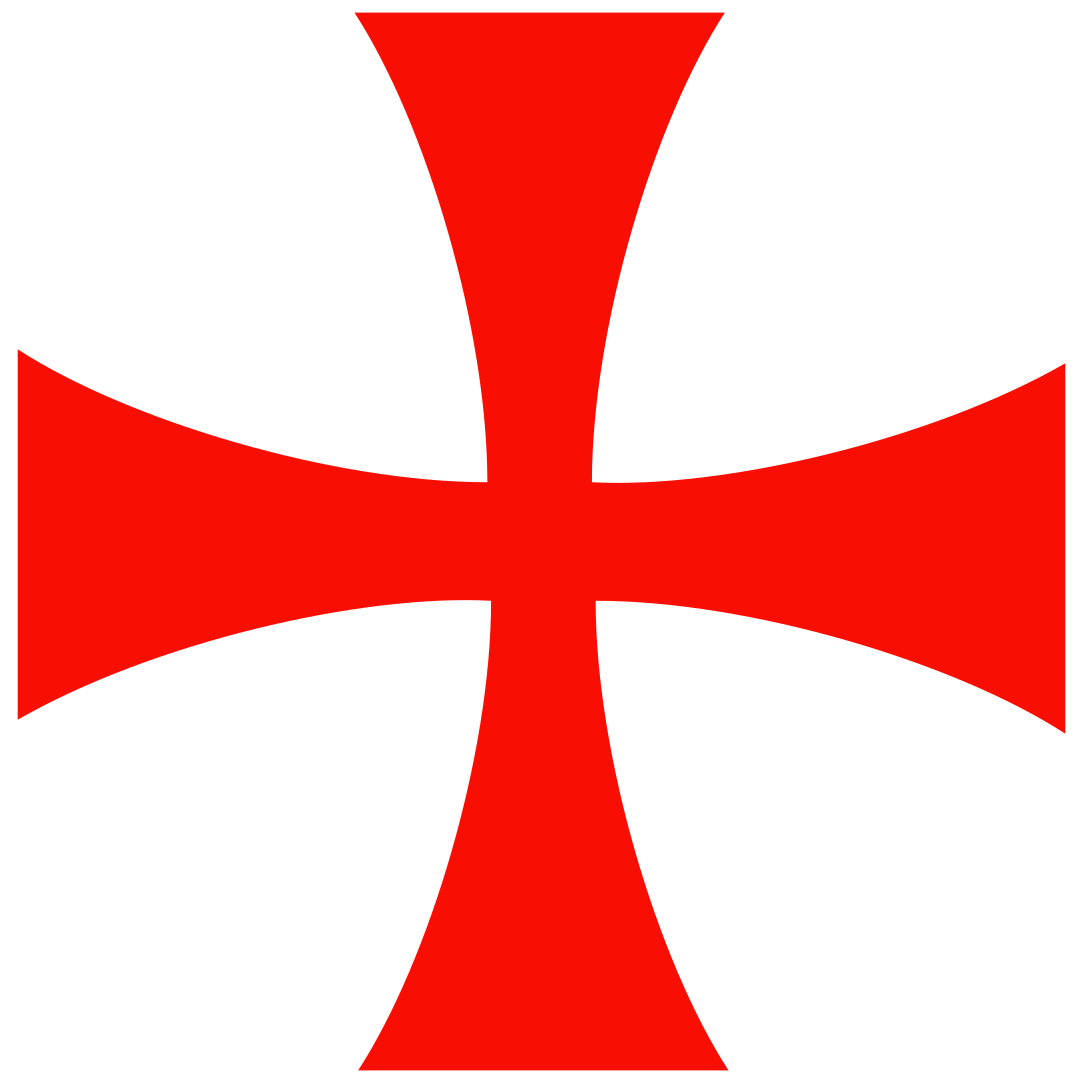 |
| Templar Cross |
 |
| Cathar Dove |
The rejection of the Holy See, as well as their beliefs seen as heretical, ignited Pope Innocent III to launch the Albungensian Crusade to attempt to purge the lands of Southern France and unite them under the Roman church in 1209. The lords of Northern France were united against the Cathars, eager to plunder their lands. Rumours of a legendary Cathar treasure were another reason for lords to join in the holy cause.
The Cathars were arrested, tortured and burnt at the stake en masse. Many of them took refuge in Beziers and, later, Carcassonne. Everyone in Beziers was put to the sword, local and refugee alike. When asked how to tell between the Cathars and the other inhabitants of the city, Arnaud-Amaury, the Abbot of Citeaux and the crusade's "spiritual" leader, replied "Kill them all. God ill know his own."
The Cathars took a last stand at their fortress at Montsegur (which translates to "Mountain of Saftey". It was there that the crusading army sieged upon the castle. Some of the Cathars were able to escape and, from some sources, carry most of the Cathar treasure out with them to a hidden cave half a days ride from the mountain. In the end, the crusaders were victorious. A generous offer was made. If the Cathars recanted their faith and confessed to heresy, they would live and only face small penance. They asked and were given a two week period to discuss the charges. The mercenaries the Cathars hired to protect them were given free passage to leave, though some stayed and converted to the Cathar faith. At the end of the two week, no one recanted. Twenty one of the Cathars in the fortress had taken the concolamentum and become Perfecti and decended the mountain. On March 2nd 1244, they were all shut into a wooden palisade and burned alive. (Serrus)
The night before the final battle, though, it is said that 4 Cathars were hidden away and, in the dead of night, decended the sheer cliff face of the western side of the mountain apparently with the legendary Cathar treasure, or, according to some sources, to reclaim the treasure smuggled out a few months before. The treasure is disputed among scholars. Some believe it to be the gold and silver wealth of the Cathars. Most believe it to be their writings and teachings. Some believe it to be the Holy Grail. That's where things get weird.
In The Holy Blood and the Holy Grail by Michael Baigent, Richard Leigh, and Henry Lincoln (a popular book claiming Jesus Christ and the figure known as Mary Magdalene had a child and thereby a bloodline), The Cathars were supposed to have the Holy Grail, brought to Gaul (which would become France) by Mary Magdalene after the crucifixion of Jesus. Esclarmonde of Foix, a female Perfecti, was said to have assumed the form of a dove (a Cathar symbol) during the final battle at Montsegur and carried off the Grail (contrary to the other story of the 4 Perfecti stealing away in the dead of night). What the Grail is, however, is disputed. The book claims one of Jesus' disciples took the Grail (the cup Jesus used at the last supper and later used to catch the blood of Christ at the crucifixion.) to Glastonbury in England (Which inspired the Grail legends of King Arthur).
What Grail was it that Mary brought to Gaul then? The Holy Blood and the Holy Grail says it may be the child of Mary and Jesus Christ. This "Grail" would then be protected by a new society known as the Priory of Sion (used in modern conspiracy novels like The da Vinci Code by Dan Brown). The Priory was apparently associated with the Order of the Temple which, in 1119, would split to become the Knights Templar. The Knights Templar were also supposed to have been in possession of not only the Grail, but the Ark of the Covenant and other historical religions relics until their dissolution, arrest, torture and execution by fire in 1307-1312. (Baigent, Leigh, Lincoln)
Fast forward around 100 years and the Grand Master of the Priory of Sion is Rene D'Anjou, son of Iolande D'Anjou and mother-in-law to Charles VIII. The play shows Jehanne going to Robert de Baudricourt court to get an escort to the dauphin. The Holy Blood and the Holy Grail and other sources tells of Jehanne going to the Duke of Lorraine, the duchy where she was born, to get an escort. It is there that Duke Charles II sends Rene D'Anjou as an escort. It's said that he came to the court with her, fought along side her at the siege of Orleans, and was maybe even her lover (though that is disputed greatly). His mother, Iolande, was a main supporter of Jehanne to the dauphin as well as his mother-in-law. She funded a great deal of her army and support (Casey remarked that she was in the movie The Messenger but not in the play). (Emerys) My question is, why is the Grand Master of the Priory of Sion (challenged with protecting the Grail) and his influential mother so interested in a farm girl who claims to hear voices? (being immaterial, and there by of the "good god" of the Cathars maybe?) A lot of questions, not as many answers. Can we use some of this information to inform decisions within the play?
Works Cited
Baigent, Michael, Richard Leigh, and Henry Lincoln. The Holy Blood And The Holy Grail / Michael Baigent, Richard Leigh And Henry Lincoln. n.p.: London : Corgi Books, 1984., 1984. Brock University Library Catalogue. Web. 9 Aug. 2013.
Emerys, Chevalier. Revelation of the Holy Grail. Lulu.com, 2007.
Serrus, Georges. The Land of the Cathars. Portet-sur-Garonne: Loubatieres, 1990.

No comments:
Post a Comment